Boron Doped Diamond BDD Electrode
BDDE
Quantity:
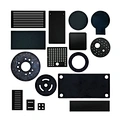
Diaboron has developed a large range of boron doped diamond (BDD) electrodes on Silicon substrates. In the facility, high quality diamond coatings are deposited on large-scale in HFCVD reactors.
To ensure customer's satisfaction with the highest quality diamond coatings, Boromond has implemented a strong quality assurance policy to guarantee customer satisfaction.
To ensure customer's satisfaction with the highest quality diamond coatings, Boromond has implemented a strong quality assurance policy to guarantee customer satisfaction.
Our boron doped diamond electrode BDD anode comes with several features:
Strong acid and alkali corrosion resistance;
Excellent adsorption resistance;
No passivation layer;
Stable in harsh environment high temperatures;
Widest electrochemical window;
High oxygen evolution potential;
Excellent mechanical properties;
Low hydrogen evolution potential;
Low background current;
No passivation layer;
Stable in harsh environment high temperatures;
Widest electrochemical window;
High oxygen evolution potential;
Excellent mechanical properties;
Low hydrogen evolution potential;
Low background current;
BDDboron doped diamond electrode specifications are systemically controlled through Diaboron's advanced metrology equipments:
Substrate: Monocrystalline Silicon or Polycrystalline Silicon
Electrode Shape: rectangle,square, mesh, disc, custom
Electrode Shape: rectangle,square, mesh, disc, custom
External Size: Custom, specific up to 500*300 mm
Film Thickness: 10-20 um
Thickness Tolerance: ±0.05mm
CVD System: Hot Filament Chemical Vapor Deposition (HFCVD)
Crystal type: Polycrystalline
Grain Size:< 2um
Film Structure: Micro Crystalline
Edges handling: Laser Cut
Boron concentration (typical): 5000-6000 ppm
Boron concentration (typical): 5000-6000 ppm
Bulk resistivity(Rv): 10-1000mΩ·cm
Solvent window: >2.7V
Oxygen evolution potential(V): ≦2.75
Hydrogen evolution potential(V): ≧-1.2
Measured Potential Window (V): ≦3.85
Nucleation side fracture stress: 500 MPa
Nucleation side fracture stress: 500 MPa
Growth side fracture stress: 500 MPa
Young's modulus: 450 Gpa
Roughness(Ra): 10 nm
Thermal conductivity: 800 W/m/K
Recommend Products